

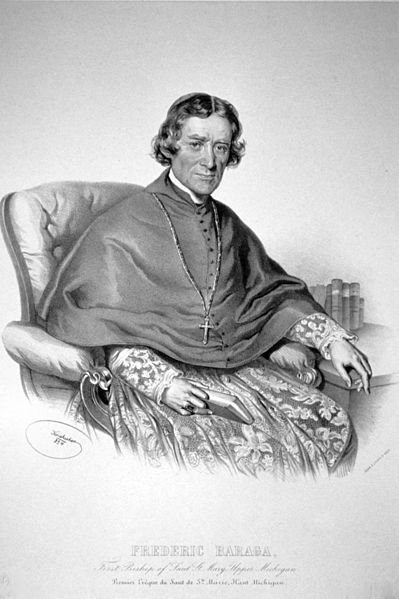
Irenaeus Frederic Baraga was born on June 29, 1797, in the manor house at Mala Vas near Dobrnič in Lower Carniola, Duchy of Carniola, Austrian Empire (now Slovenia), the fourth of five children to Janez Nepomuc Baraga, an estate overseer, and Marija Katarina Jožefa Jenčič.
Orphaned by his mother's death in 1808 and father's in 1812, he lived with family friend Jurij Dolinar in Ljubljana, becoming fluent in Slovenian, German, French, Latin, and Greek amid Napoleonic upheavals.
After graduating from the University of Vienna law school in 1821, influenced by Redemptorist co-founder Clement Hofbauer, he entered Ljubljana seminary and was ordained a priest on September 21, 1823, for the Archdiocese of Ljubljana by Bishop Augustin Johann Joseph Gruber.
Assigned as assistant pastor at St. Martin's near Kranj and Metlika, Baraga opposed Jansenism and authored the Slovenian spiritual work Dušna Paša before seeking foreign missions.
| Full Name | Friderik Baraga |
| Other Name | Irenaeus Fridericus Paraga |
| Gender | Male |
| Occupation | Missionary |
| Date of Birth | 29-June-1797 (70 years) |
| Birth Year | 1797 |
| Birth Location | Mala Vas, Duchy of Carniola, Austrian Empire |
| Death Time | 19-January-1868 |
| Death Location | Marquette, Michigan, United States |
Sponsored by Vienna's Leopoldine Society, he arrived in New York on December 31, 1830, reached Cincinnati in January 1831, and ministered to German immigrants while learning Ottawa, publishing Otawa Anamie-Misinaigan, the first Ottawa catechism and prayer book, in 1837.
From L'Arbre Croche (1831–1835), he moved to Grand River (Grand Rapids, 1833), La Pointe, Wisconsin (1835–1843, joined by sister Antonija), and L'Anse, Michigan (1843), earning the nickname "Snowshoe Priest" for winter travels on snowshoes to Ottawa and Ojibwe missions, protecting natives from land loss.
Pope Pius IX named Baraga titular Bishop of Amyzonia and Vicar Apostolic of Upper Michigan on July 28, 1853, consecrated November 1 in Cincinnati by Archbishop John Purcell; the vicariate became the Diocese of Sault Sainte Marie in 1857 with him as bishop.
Amid mining booms drawing immigrants, he managed diverse populations with few multilingual priests, traveling Europe twice for funds, selling imperial gifts, and writing letters inspiring John Neumann and Francis Pierz to emigrate. He authored an Ojibwe grammar (1850), dictionary (1853), over 100 hymns, and a diary in multiple languages, with works republished into the 20th century.
In 1865, the diocese expanded to Sault Sainte Marie and Marquette, his final seat; health failing from strokes and deafness, Baraga died January 19, 1868, in Marquette, buried in St. Peter Cathedral. Declared venerable by Pope Benedict XVI in 2012 after a cause opened in 1952, his legacy includes missions, linguistic contributions, and places named after him like Baraga County, Michigan.
Johann Nepomuc Baraga
FatherMaria Katharine Josefa
MotherPhoto Gallery


FAQ (Frequently Asked Questions)
Friderik Baraga was 70 years old
Friderik Baraga was born on 29-June-1797
Friderik Baraga was born in Mala Vas, Duchy of Carniola, Austrian Empire
References
- https://en.wikipedia.org/wiki/Friderik_Baraga
Recently Added



Popular Personalities


